

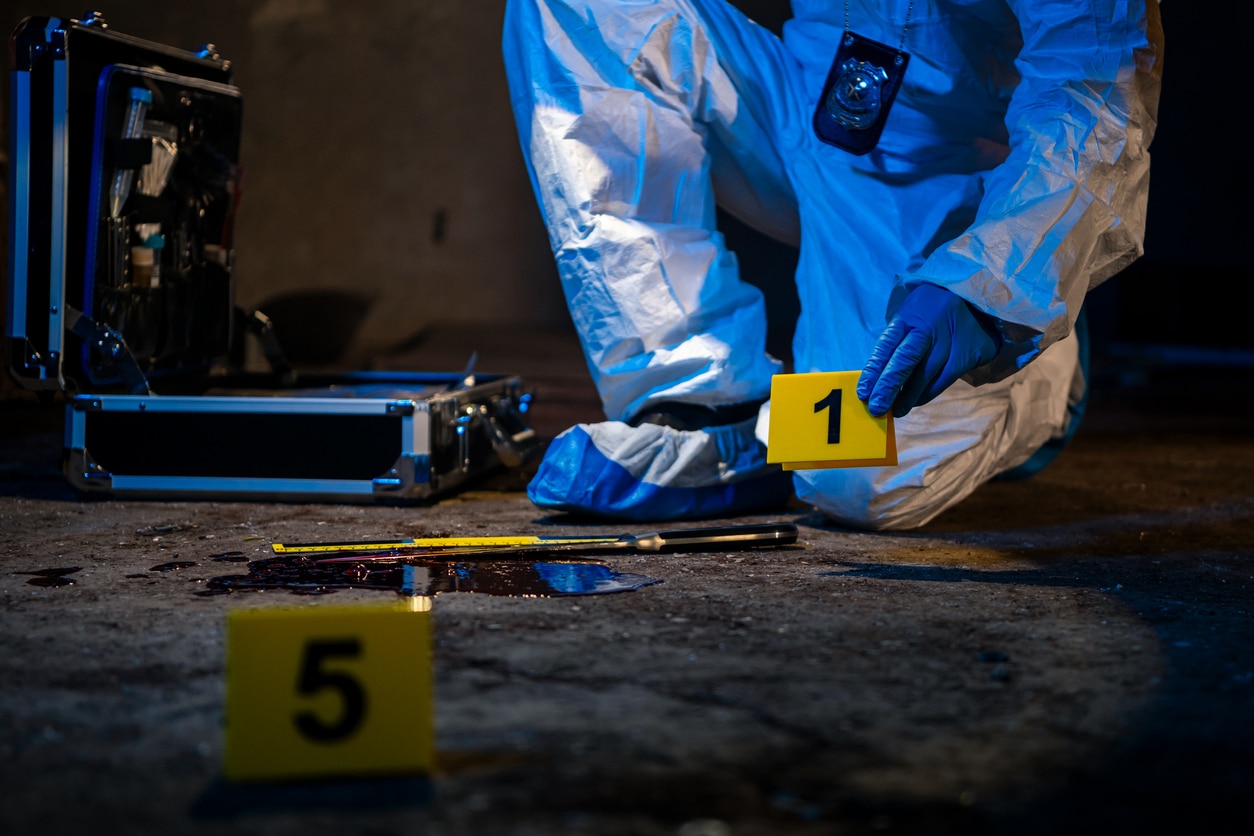
A DNA “match” feels like the end of your case. It isn’t. DNA evidence can be wrong, overstated, contaminated, or misinterpreted — and Louisiana law gives you the right to challenge every piece of it. The lab is not infallible. The analyst is not neutral. The number the prosecutor quotes is not the whole story. If your case turns on DNA, what follows is what actually matters, and where these cases break.
A “match” is a statistic, not a fact
Television sold you a lie. No machine says “this is Joe and only Joe.” A DNA result is a probability. An analyst develops a profile, compares it to a sample, then estimates how rare that profile is in the population. That estimate — the random match probability — is where cases are won and lost.
Say John’s DNA is found on a weapon. The lab reports a match. But John lives in that house. He touched that object a hundred times for innocent reasons. DNA cannot tell you when it got there. It cannot tell you how. It cannot tell you who pulled a trigger. It tells you whose cells are present, and nothing more. That gap — between “his DNA is here” and “he did this” — is where your defense lives.
The prosecutor will quote you a number that sounds like certainty. One in a billion. One in a trillion. Those numbers depend on assumptions: which population database the lab used, how many genetic markers it tested, how it handled ambiguous data. Change the assumptions and the number changes. A figure that sounds like proof can rest on choices a jury never hears about — unless your lawyer drags them into the light.
Touch DNA and the problem of transfer
Modern labs can build a profile from a few dozen cells. That sounds powerful. It is also dangerous. The less DNA you start with, the more guesswork goes into reading it, and the easier it is for DNA to arrive in ways that have nothing to do with a crime.
This is secondary transfer, and it is real. Joe shakes hands with John. John later touches a gun. Joe’s DNA can end up on that gun without Joe ever seeing it. Studies have shown DNA moving across two, even three, points of contact. A person can deposit DNA on an object they never touched. In a system that treats a “match” as guilt, that is terrifying.
Touch DNA also says nothing about timing. A profile lifted from a steering wheel does not tell you whether the person drove the car that night or a week earlier. It does not distinguish the owner from the thief. When the State builds a case on a few cells from a touched surface, the right question is not “is it his DNA?” It is “so what?” Presence is not participation.
Mixtures: where labs get it wrong
Most real evidence is not a clean sample from one person. It is a mixture — two, three, sometimes four people or more DNA on the same swab. Interpreting a mixture is hard, and it is subjective. Two qualified analysts can look at the same electropherogram and disagree about how many people contributed, which peaks are real, and which are noise.
That subjectivity has consequences. In a well-known independent re-analysis study (Dror & Hampikian, 2011, revisiting a Georgia case), seventeen qualified analysts blind to the original case context reviewed the same DNA mixture: twelve excluded the suspect, four were inconclusive, and only one reached the original lab’s “cannot be excluded” conclusion. Same data. Different answers. When the difference between “included” and “excluded” depends on which analyst sat down at the computer, the result is not the hard science the jury imagines.
To manage mixtures, crime labs now lean on probabilistic genotyping software — programs that calculate a likelihood ratio for whether a person contributed to a sample. The software is marketed as objective. It is not magic. It runs on assumptions, parameters, and settings chosen by people. Different programs, fed the same data, can produce materially different results. Run the same mixture twice with different settings and the answer can move.
The software fight: source code and validation
Here is where most defense lawyers stop, and where the real battle begins. The companies that sell probabilistic genotyping software often guard their source code as a trade secret. They tell courts the defense cannot examine the very engine that produced the evidence against the accused. Think about that. The State asks a jury to convict based on a number generated by a black box no one is allowed to open.
That should not stand, and increasingly courts agree it is at least worth fighting. A defendant has a right to confront the evidence against him. When the “witness” is an algorithm, confronting it means examining how it works — its assumptions, its known errors, its validation studies. Defense counsel should demand the developmental and internal validation records, the software version used, the laboratory’s own validation of that software, and any history of bugs or corrections. Validation is not a formality. A program validated on two-person mixtures may be unreliable on a degraded four-person sample, yet labs use it anyway.
You also demand the lab’s accreditation records and proficiency testing history. Labs make mistakes. Analysts have been caught dry-labbing results, skipping controls, and misreporting data. A lab that failed a proficiency test, or that has a pattern of contamination, is a lab whose conclusions deserve scrutiny — not deference.
Chain of custody and contamination
A DNA result is only as good as the chain behind it. Every link can fail. Evidence gets contaminated at the scene by first responders. Samples get swapped or mislabeled in the lab. Analysts deviate from protocol. Equipment goes uncalibrated. Reference samples cross-contaminate evidence samples. Data gets deleted.
Say Joe is charged based on a swab collected at a chaotic scene by an officer who did not change gloves, stored in a hot trunk for two days, then run by an analyst who skipped a negative control. The profile the lab reports might be real. The handling might have destroyed its reliability. Those are two different attacks, and both can win. One says the result is wrong. The other says the result cannot be trusted, which for the State’s burden is just as fatal.
Contamination is not hypothetical. There are documented cases of a “phantom” profile haunting investigations for years before someone realized the DNA came from the swabs themselves at the factory. If manufacturing can contaminate evidence, so can a busy lab on a Friday afternoon. The defense that knows to ask about negative controls, extraction blanks, and contamination logs is the defense that finds these failures.
The legal framework: admissibility and confrontation
The scientific attacks have legal teeth, and Louisiana law supplies them. DNA evidence is expert evidence, and expert evidence is not admitted automatically. Under La. C.E. art. 702 and State v. Foret, 628 So. 2d 1116 (La. 1993), Louisiana’s version of the Daubert reliability standard, the trial court is a gatekeeper. The methodology must be reliable, properly applied, and grounded in accepted science. A challenge to whether a particular method — say, probabilistic genotyping on a low-template mixture — has been validated for the conditions in your case is a challenge the court must take seriously. In a second-degree murder prosecution, where the science may be the entire case, that gatekeeping question can decide everything.
The Confrontation Clause matters too. The analyst who developed the profile and reached the conclusion should face cross-examination. Under Melendez-Diaz v. Massachusetts, 557 U.S. 305 (2009), and Bullcoming v. New Mexico, 564 U.S. 647 (2011), the State cannot launder an opinion through a supervisor or a report and deny the accused the chance to question the person who actually did the work. When the analyst takes the stand, that is the moment to expose the assumptions, the deviations, and the subjectivity the report hides.
And discovery is the foundation of all of it. You cannot challenge what you cannot see. The defense is entitled to the underlying data — the electropherograms, the bench notes, the calibration records, the software parameters, the validation studies. A report alone is not enough. The report is the conclusion. The data is the truth, and the two do not always agree.
Why the right expert changes everything
Most criminal defense attorneys hire a DNA expert and hope the science holds up on cross. At The Ambeau Law Firm, the lawyer is one. Jarrett Ambeau holds a Master of Science in Forensic DNA and Serology from the University of Florida. Louisiana district courts have qualified him as an expert in Forensic DNA Interpretation. He serves as an observer on the American Academy of Forensic Sciences DNA standards body, and has tried a substantial number of felony cases to verdict, many of them turning on forensic evidence. You can read more about our forensic DNA expertise and how it shapes the defense.
That means the science is not outsourced and then hoped for. It is read, understood, and met head-on, in the same courtroom, by someone who can sit with the electropherograms and see what the analyst missed. When the lawyer can cross-examine the State’s analyst on the data itself — not just the conclusion — the case stops being one-sided. This matters most in violent crime cases, where a single swab can carry the weight of the entire prosecution.
Frequently Asked Questions
Can DNA evidence be wrong?
Yes. DNA evidence can be contaminated, mislabeled, misinterpreted, or statistically overstated. A reported “match” is an estimate, not proof of guilt, and every step from collection to analysis can fail.
What is secondary transfer?
It is DNA arriving on an object or person indirectly — for example, through a handshake or a shared surface. It means your DNA can be found somewhere you never were, which undercuts the assumption that presence equals participation.
Why are DNA mixtures so easy to challenge?
Because interpreting a mixture is subjective. Qualified analysts can disagree on how many people contributed and which data is real. When the answer depends on the analyst or the software settings, the result is open to serious challenge.
Can my lawyer examine the lab’s software and data?
Yes, and they should. The defense can seek the source code or validation records for probabilistic genotyping software, plus the bench notes, electropherograms, and accreditation history. National standards bodies such as the National Institute of Standards and Technology (NIST) publish guidance on forensic DNA testing that helps measure a lab’s work against accepted practice.
Does a DNA match mean I will be convicted?
No. A match suggests your DNA may be present — not when, not how, and not that you committed a crime. The State still must prove every element beyond a reasonable doubt.
Why hire a lawyer with forensic DNA training?
Because the science is the case. A lawyer who understands DNA interpretation can cross-examine the analyst on the methodology and the data, expose hidden assumptions, and force the State to prove its science is sound.
A DNA result is not a verdict
Do not assume the result is correct. Do not let anyone tell you a match means a conviction. The science is challengeable, the law gives you the tools, and the State’s number is only as strong as the work behind it. Get the underlying data into the hands of someone who can actually read it — before the prosecutor frames the story for the jury. Charged with a serious crime in Baton Rouge or anywhere in Louisiana? Call The Ambeau Law Firm at 225.330.7009 for a confidential consultation. The lab had its turn. Now it’s yours.
Attorney Jarrett Ambeau also offers forensic DNA consulting and expert witness services to defense attorneys nationwide through Ambeau Forensics.